Wednesday, November 9, 2011

Self-Assembly

This video was very interesting as it gives a peek into a possible future. It is possible that one day, humans will be designing machines or buildings that can construct and repair or even replicate themselves.
This article discusses further uses for self-assembly not touched upon in the video, including drug delivery mechanisms.

Monday, November 7, 2011

Sterillite 3 Drawer Cart


I have been using these carts for storage for the past four years, and they drive me just as crazy now as they did at the very beginning. The drawers slide easily, until they are filled. The plastic frame is too flexible and begins to collapse, exerting pressure on the drawers and making them very difficult to move in or out. The weight limit that allows the cart to remain fully functional is unrealistically small. Even loosely filling the drawers with clothes or other lightweight objects prevents the drawers from opening and closing properly.
In addition to being too weak in compression, the frame is also too weak in tension. The plastic frame is made of three separate components which stack and snap together. These snaps are very weak, and often the frame will fall apart if lifted, even if all of the drawers have been removed.
The design does not adequately consider that users will be filling the drawers, or will ever need to pick up the cart.

L.L. Bean Personal Organizer

This is my single favorite piece of luggage.


I am allergic to nearly all soaps and shampoos, so all of my toiletries have to come with me whenever I travel. Most toiletries bags aren't large enough for this, and are little more than a rectangular soft case. Until I found this bag, Ziplok bags were the best solution that I had found, as they were large and their transparency made it easy to locate items. This bag, however, if perfect. It is large enough to hold everything that I need and has enough pockets and pouches to keep everything organized. Large bottles each have a compartment in the main body of the bag, while small things like makeup and spare contacts can be placed in smaller pockets. The bag folds up flat enough to be placed in a suitcase. Another great feature of this bag is the hanging hook. When the bag is opened, a hook swings out and can be used to hang the bag in the hotel bathroom or another convenient location to keep everything at hand and countertops clear.


2007 MacBook Body

I always thought that my MacBook was part of a strange batch where something went wrong. From about three months after I bought it, small chunks of plastic started to break off of the body, bit by bit.
Like this.
Or like this.
Unfortunately, this was not an isolated incident at all. The plastic of the upper keyboard case is too thin and weak and snaps off when pressed down against the harder outer shell. The problem is especially common for people who carry the computer in a backpack, as pressure on the closed case forces the shell and keyboard cover together. It is a shocking lack of durability for a computer which is otherwise so well designed and engineered. Mine has handled multiple tumbles without a single problem, but is falling apart because I carry it to class in a backpack.

Sunday, October 30, 2011

Teen Titans "Raven" Cape


Teen Titans was a children's cartoon that aired from 2003-2006 and it is one of my very favorite cartoons. I wanted to be Raven for Halloween, but she was one of the less popular characters and most of the official licensed costumes were for children. Most parts of the costume were easy to find substitutes for, but the distinct "beak" shape of her hooded cape was a crucial part of the costume.


I had to design my own pattern to create the cape. I started out with sketches of how I wanted the hood to fall, as that was the part that I cared about most, before moving on to prototypes made from newspaper. Once I was satisfied with the shape, I used my newspaper patterns to cut out the fabric I would need and started sewing. It isn't a perfect approximation, but it was good enough to fool a few small children who were out trick-or-treating, so that is good enough for me.

Thursday, October 13, 2011

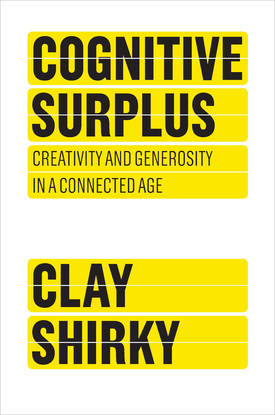
Cognitive Surplus by Clay Shirkey

I waited for months for this book to be available from UB's library, and it did not disappoint. I was first introduced to Clay Shirky's work in my "Machine Culture" class in sophomore year. It was in the Digital Media Studies department and explored the intersections and interactions between machines, society, and culture, and it was probably my favorite class that I have ever taken.
"Cognitive surplus" is the free time and energy that each indivdual possess each day as a result of labor-saving devices and systems. Cars and planes decrease the time necessary for travel, washing machines and dishwasher free up time that would otherwise have been spent scrubbing... Most people have hours of free time on their hands every day because of things like these, but before widespread use of the internet most of this time was spent "consuming," watching television of movies, reading books or magazine articles, because normal people did not have access to the tools and distribution channels necessary to create. But all of that has changed, and Cognitive Surplus explores the world that this drastic change in paradigm makes possible. From Wikipedia and open-source software, to fan-subbing and fan-dubbing Japanese Anime communities, to the FoldIt protein game, the connectivity made possible by the internet has ripped the power of creation from the hands of the few and put it into the hands of the many.
This really showed me that anyone can be a designer now. Blender is completely free, and internet-order 3D printing is incredibly affordable- often around $100. Better yet, a MakerBot open source 3D printer is only around $1,500. Websites like Thingverse share the data files needed to print household objects such as cookie cutters, tape dispensers, toys, ornaments, jewelry: anything imaginable. It will be increasingly important for designers in the commercial realm to remember that they are no longer the only ones with access to the tools of creation and distribution.

Wednesday, October 12, 2011

Stephanie Clifford: Packaging is all the rage, and not in a good way


http://www.nytimes.com/2010/09/08/technology/08packaging.html?_r=1
This article talked about the pressure that Amazon is placing on their suppliers to make packaging less frustrating and less bulky. Packaging like glossy cardboard and clamshells, meant to make the product attractive and more difficult to steal are unnecessary when the product is sold online. The needs of online customers are different from the needs of retail customers and packaging is slowly beginning to reflect these differences.